"Streetcar Named Desire" The Journal
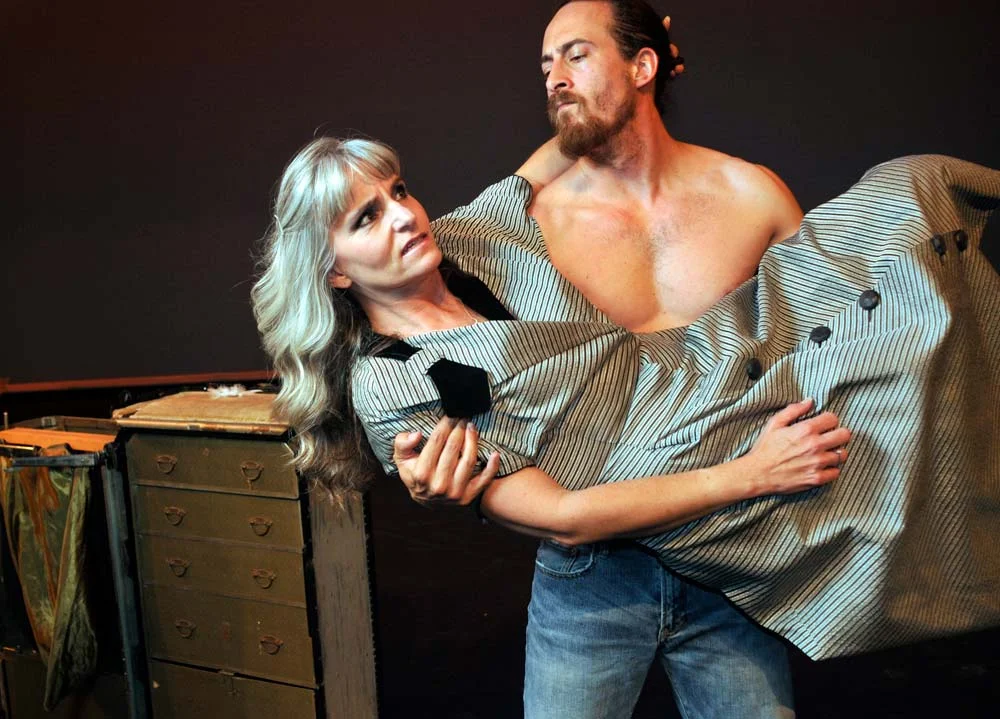
Running through September, Matt Andrade as Stanley Kowalski, at the National Hispanic Cultural Center.
By David Steinberg / Journal Staff Writer
When Matt Andrade was a senior at Highland High School, he portrayed Stanley Kowalski, the male lead in Tennessee Williams’ famous play “A Streetcar Named Desire.” The director of that production was drama teacher Salomé Martínez-Lutz.
“The students that year were very mature for their age, very serious about their work. They cared about each other and they cared about theater,” Martínez-Lutz recalled.
Andrade remembers that he “missed a lot of stuff (in the script). I was too young and inexperienced.”
‘A Streetcar Named Desire’
WHEN: 7 p.m. Thursday, Sept. 29, Sept. 30 and Oct. 1, and 2 p.m. Oct. 2
WHERE: National Hispanic Cultural Center, 1701 Fourth SW
HOW MUCH: $10, $15 and $20 for the general public in advance at the NHCC box office or by calling 724-4771. $2 discount for students and seniors.
Now, 13 years later, Martínez-Lutz and Andrade are reunited in a new production of the play staged by Teatro Nuevo Mexico and the National Hispanic Cultural Center. It will run Thursday, Sept. 29, through Oct. 2 at the NHCC.
Martínez-Lutz returns as the director and Andrade is back as Stanley.
Andrade said he won’t be trying to re-create Marlon Brando, who had the same part in the original Broadway production and in the movie version. In fact, there are sharp differences in portrayals.
“I’ll be kinder toward Stella (his wife),” said Andrade, who works in Los Angeles as an actor, an associate producer and an assistant director on television shows.
“I build a bigger arc of character. I want the arc to go from sensitivity – he’s more playful with Stella, more intimate, more caring and shows a lot of physicality – to his animal, destructive self towards the end.”
The tension in the play occurs with Stella’s sister, Blanche DuBois, coming from Mississippi to stay with the couple in their New Orleans apartment. Stella feels obliged to allow her sister to be with them.
“Stella doesn’t feel she can turn her sister out on the street,” said Yolanda Luchetti-Knight, a junior theater major at the University of New Mexico, who portrays Blanche.
Blanche, a Southern belle, had remained on the family plantation to care for dying family members, a fact that she resents. And she suffered trauma when her husband committed suicide. Blanche felt his suicide was her fault.
“Blanche could never pull away and eventually, because she didn’t know how to manage money and was no administrator, she lost the plantation,” Martínez-Lutz noted.
By contrast, Stella had opted to leave for the big city.
The director said the way Williams gives his characters “a certain vocal line, they’re speaking his poetry. It’s just very illuminating to learn about the characters this way.”
Luchetti-Knight thinks that every audience member can relate to a certain aspect of each of the characters.
There’s Blanche’s sex appeal and femininity, which is her way to relate to men, she said.
Martínez-Lutz thinks that her brother-in-law Stanley is a brutish, coarse person who could never be part of the beauty she sees in the world. Stella is pulled emotionally in two directions, to her husband and to her sister.
The 1947 play, which is in the pantheon of American theater, won the Pulitzer Prize for Drama.
“Tennessee Williams established himself with this play,” Martínez-Lutz said. “It is an incredibly insightful play regarding the psychological aspects of being human.”
Among the other actors in the production are James Chavez as Steve Hubbell, Gene Ornelas as Mitch, Monica Roybal as the nurse, Jose “Pepe” Gallardo as the young man, Manuel Aragon as the doctor, Joseph Wasson as Pablo and Nelly Maria Kirmer as two minor characters.
The production is part of the Albuquerque Theatre Guild’s yearlong celebration of the centennial of Williams’ birth in 1911. Local actor-playwright Phil Bock had sent a notice to guild members suggesting the celebration.
“The moment I saw the notice in an email I immediately called Phil and said I was interested in doing ‘A Streetcar Named Desire’ with a nontraditional cast,” Martínez-Lutz said.
“That means people of color who wanted to audition for roles. … I wanted to work with people who may be disenfranchised for one reason or another. … As it turned out I have Latinos and non-Latinos.
Martínez-Lutz, who is the artistic director of Teatro Nuevo Mexico, said this is the organization’s only show for the 2011-12 season. She cited a lack of funding for operating and production costs.
“I will put it on hiatus while we look for funding and as we restructure our organization. I think we need to talk about whether the mission is still viable,” she said.
There are nine local productions celebrating the 100th anniversary of Tennessee Williams’ birth under the Albuquerque Theatre Guild’s umbrella. Most are productions of plays he had written. Besides “A Streetcar Named Desire,” these are the remaining shows this year: